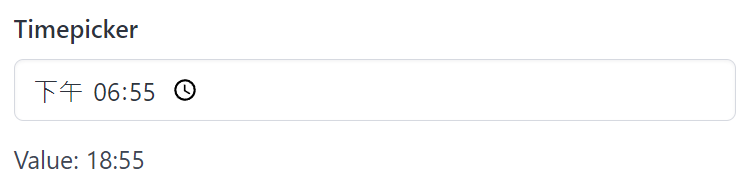
TimePicker
TimePicker create a timepicker and return its selected time of day.
API
func TimePicker(c *tgframe.Container, label string, conf ...*TimePickerConf) *time.Time
cis Parent container.labelis the label for timepicker.confis an optional configuration, at most one.- Return the selected time of day, as that clock on 1 January year 0 in UTC — only the clock is meaningful. nil if no time is selected.
// TimePickerConf is the configuration for the TimePicker component.
type TimePickerConf struct {
	tgframe.Base // ID

	// Default is the time of day the picker starts on, read to the minute. It
	// is only read until the app user first picks one.
	Default *time.Time

	// Disabled is true if the timepicker is disabled.
	Disabled bool
}

func (c *TimePickerConf) SetDefault(v time.Time) *TimePickerConf
Only the clock is kept: a date on the Default is dropped, the way
DatePicker drops the clock. Read the hour and minute off it
rather than the date:
day := tgcomp.DatePicker(p.Main, "Day")
at := tgcomp.TimePicker(p.Main, "At")
if day != nil && at != nil {
	when := day.Add(time.Duration(at.Hour())*time.Hour +
		time.Duration(at.Minute())*time.Minute)
	tgcomp.Text(p.Main, "Value: "+when.Format("2006-01-02 15:04"))
}
Example
	timeValue := tgcomp.TimePicker(p.Main, "TimePicker")
	val := ""
	if timeValue != nil {
		val = timeValue.Format("15:04")
	}

	tgcomp.Text(p.Main, "Value: "+val,
		&tgcomp.TextConf{ID: "timepicker_result"})
Starting on a time, until the app user picks another:
tgcomp.TimePicker(p.Main, "TimePicker",
	(&tgcomp.TimePickerConf{}).SetDefault(
		time.Date(0, time.January, 1, 9, 30, 0, 0, time.UTC)))