Button
Button create a button and return true if it's clicked.
API
func Button(c *tgframe.Container, label string, conf ...*ButtonConf) bool
cis Parent container.labelis the text on button.confis an optional configuration, at most one.
// ButtonConf is the configuration for the Button component
type ButtonConf struct {
	tgframe.Base // ID

	// Color defines the color of the button
	Color tcutil.Color

	// Disabled indicates whether the button should be initially disabled
	Disabled bool
}
Example
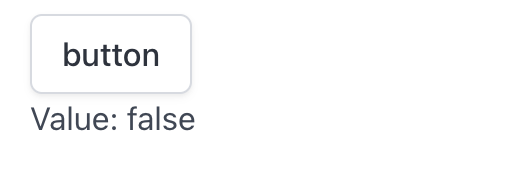
	btnClicked := tgcomp.Button(p.Main, "button")
	tgcomp.Text(p.Main, fmt.Sprint("Value: ", btnClicked),
		&tgcomp.TextConf{ID: "button_result"})
Two buttons with the same label claim the same id, so one of them needs its own:
tgcomp.Button(p.Main, "Save")
tgcomp.Button(p.Main, "Save", &tgcomp.ButtonConf{ID: "save_all"})
Asking before the button is drawn
func ButtonClicked(c *tgframe.Container, label string, conf ...*ButtonConf) bool
Button reports the click where it is written, which is a problem when the
button belongs below the content it changes — a "Load details" at the bottom
of a card. ButtonClicked reads the click off the run's state instead, so the
page can handle it first and write the content once:
if tgcomp.ButtonClicked(p.Main, "Load details") {
	details = fetchDetails()
}

tgcomp.Text(p.Main, details)
tgcomp.Button(p.Main, "Load details")
It reads the click, it does not draw the button: give it the same label and
conf the Button call gets, and it derives the same id. Where the button
carries a ButtonConf.ID, pass that conf to both — sharing one variable is the
way to keep them from drifting apart:
conf := &tgcomp.ButtonConf{ID: "load_details"}

if tgcomp.ButtonClicked(p.Main, "Load details", conf) {
	details = fetchDetails()
}

tgcomp.Text(p.Main, details)
tgcomp.Button(p.Main, "Load details", conf)
It is true for exactly the run that handles the click on a button the page has
on the screen — the same as what Button returns there — and false again on
the next run. A click id naming a button the last run never drew is not one:
the click comes from the client, and ButtonClicked is asked before the page
has written anything to check it against, so it checks that itself.
Don't compare State.GetClickID() with the conf id yourself: the click id
carries the component name in front of it
(Identity),
and comparing it by hand skips that check.